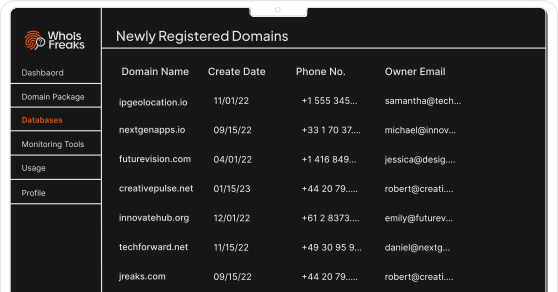
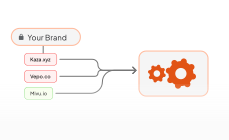
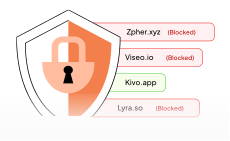
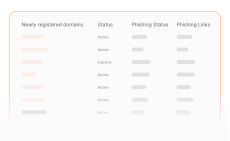
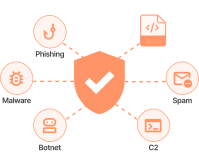
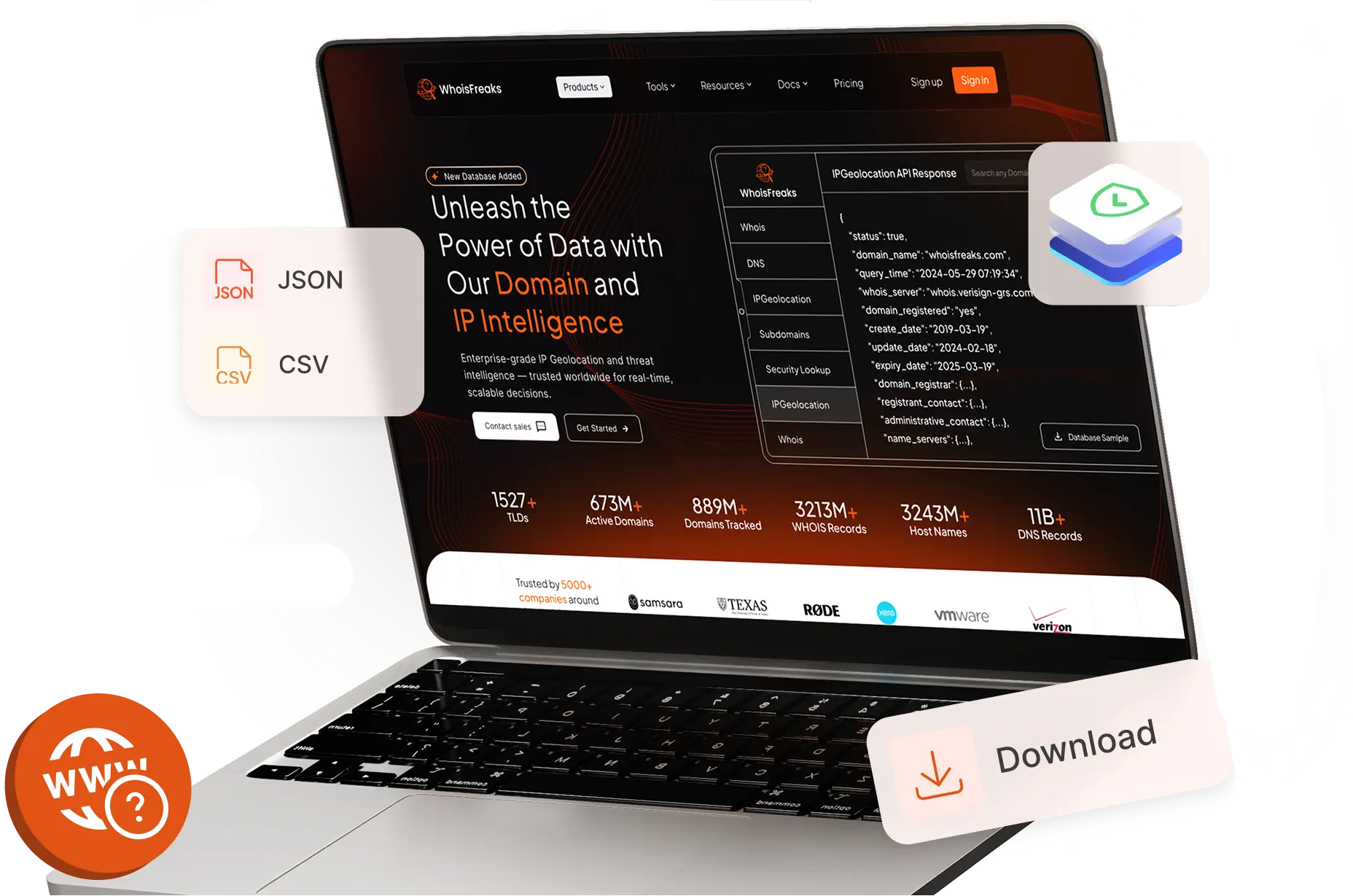
The Newly Registered Domains feed lists every domain registered worldwide each day across 1528+ TLDs, enriched with WHOIS contact records and DNS records (A, MX, NS, TXT). Security teams use it to surface phishing and malware infrastructure within hours of registration. Brand teams use it to monitor cybersquatting and lookalike domains. Delivered twice daily as CSV download or REST API.
Pricing
Three tiers based on how much enrichment your workflow needs. All tiers cover 1528+ TLDs and ship twice daily.
Domains list without WHOIS & DNS. Best for blocklists and drop-catch monitoring.
Newly domains list with WHOIS data. Best for threat-intelligence pivots and brand investigations.
WHOIS records filtered to remove privacy proxies and disposable emails.
DNS records for newly registered domains, available as a separate enrichment tier.
Our Products
Product
Our Recently Registered Domains package provides WHOIS records, DNS details, cleaned WHOIS data, and lists of newly registered domains. Files are delivered as soon as they are prepared: previous-day ccTLDs are typically available around 3:00 AM UTC, and current-day gTLDs are typically delivered around 5:00 PM UTC, along with their DNS and WHOIS records.
Statistics
Product
Comparision
This comparison highlights the technical advantages of the WhoisFreaks Newly Registered Domains (NRD) feed against common free and paid competitors.
Features
Pull the daily feed into your detection pipeline, threat-intel platform, or DNS blocklist with one API call or one CSV download.
WHOIS and DNS records for 1528+ TLDs covering both gTLDs (generic top-level domains like .com, .net, .org) and ccTLDs (country-code top-level domains like .uk, .de, .jp) across 200+ countries.
Access newly registered domains in JSON or CSV formats, structured for quick ingestion into security workflows.Import the data into your SIEM, SOAR, or threat-intelligence platform without extra cleanup.
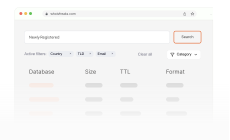
Filter by country, TLD, registrar, registrant email, registrant name, or organization before download.Sort by domain name, expiry, creation, or update date, and export only the CSV columns you need.
Pull data through the REST API for automated pipelines, using your API key as a request parameter.For one-off analysis or smaller workflows, download ready-to-use CSV files directly from the billing dashboard.
Use Cases
Security teams enrich detection pipelines with fresh-registration indicators of compromise.
Pivot from one C2 or malware-delivery domain to its registration cluster using registrar, nameserver or registrant, then export IoCs to MISP, OpenCTI, or other TI platforms.
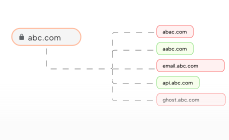
Track domains targeting your trademarks, typos, or subdomains, then pair NRDs with Reverse WHOIS API to uncover every domain tied to a known abusive registrant.
Find new domains tied to your brand, products or infrastructure keywords, then feed matches into EASM tools to catch shadow IT, contractor domains, and missed assets.
Block or rate-limit newly registered domains from the last 7, 14, or 30 days, with CSV support for Pi-hole, AdGuard Home, Zscaler, Cisco Umbrella, Quad9, and RPZ resolvers.
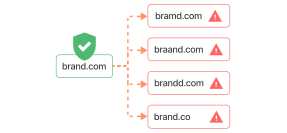
Match new registrations against brand terms, executive names, and homoglyphs to catch lookalike domains early, with cleaned WHOIS exposing stronger detection signals.
Pipe the daily feed into Splunk, Sentinel, MISP, or OpenCTI, with WHOIS and DNS data for quick pivots from suspicious domains to registrar and hosting details.
The newly registered domains feed gives security teams an early-warning signal for phishing and brand-abuse infrastructure, and gives domain teams a daily window into registration trends across 1528+ TLD.
Newly registered domains are domain names that are just registered, are brand new or re-registered after being dropped/deleted. By our broad and upto-date database you can get the list of recently registered domains and their complete WHOIS information daily.
Check out our new domain names list here.
The Newly Registered Domains Cleaned WHOIS dataset contains entries featuring active Registrant email addresses, while excluding entries associated with disposable domains and proxy services, thus guaranteeing the accuracy of the information provided.
Check out our new domain names list here.
You have two options. Use the REST API for automated pipelines, with API-key authentication and the schema documented in the API Reference . Or download CSV files from the billing dashboard, which is faster for one-off analysis and small teams.
A free sample CSV is available without an account: Download Sample .
You can get WHOIS information for newly registered domain names automatically through our recently registered domains WHOIS API on a daily basis. Checkout Newly Registered Domains API documentation to automate the process.
Check out our new domain names list here.
The WHOIS files for newly registered domains are updated for download at the following times:
We also notify you via email when each file is ready to download. Further, you can check file status through API.
Check out our new domain names list here.
Yes, you can check details of WHOIS files through Files status API.
Check out our new domain names list here.
Yes, there is a limit to download WHOIS files. but it can be extended. Download limit will be shown in billing dashboard with usage.
Check out our new domain names list here.
For newly registered websites, you have two options:
Check out our new domain names list here.
No, our service does not support new domain registration. We only provide lists of newly registered domains for both gTLDs and ccTLDs. For new domain registration, you can use platforms like GoDaddy or Namecheap. However, if you need domain name suggestions, you can utilize our Domain Availability API to find the perfect name.
You can use our Domain Name Availability tool to check if any domain name is available.
Check out our new domain names list here.
Yes. The CSV format imports directly into Pi-hole, AdGuard Home, Zscaler, Cisco Umbrella, Quad9, and any RPZ-capable resolver. A common pattern is to block or rate-limit traffic to domains registered in the last 7, 14, or 30 days, which significantly reduces phishing and malware exposure.
The Domains Only tier is the cheapest path if blocking is your only use case. Full implementation guidance is in the How to Block Newly Registered Domains section above.
Integrate newly registered domains with WHOIS and DNS data into your detection pipeline, brand-monitoring workflow, or domain-research stack. Start with a free CSV sample or talk to our team about volume-based API pricing.