WHOIS API: Real-Time Domain Lookup for Any Domain
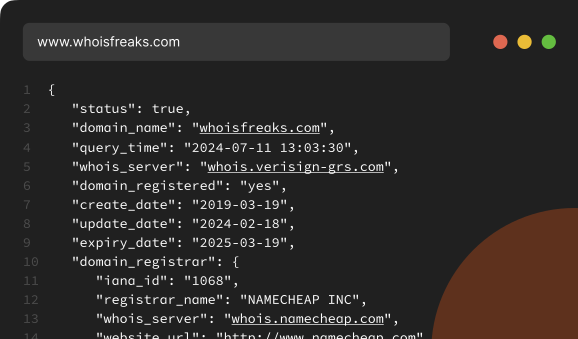
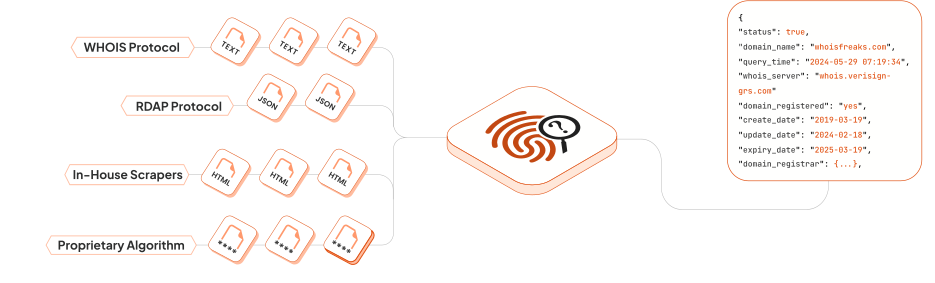
Query live, structured WHOIS data for any domain and get owner details, registrar, registration dates, nameservers - returned as clean JSON or XML in milliseconds. No caching. No stale records. Directly from authoritative WHOIS servers and RDAP on every request.
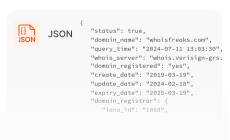
curl --location --request GET 'https://api.whoisfreaks.com/v1.0/whois?whois=live&domainName=whoisfreaks.com&apiKey=API_KEY'[
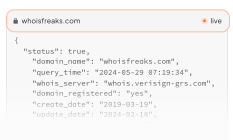
{
"status": true,
"domain_name": "whoisfreaks.com",
"query_time": "2026-09-24 16:16:44",
"domain_registered": "yes",
"create_date": "2019-03-19",
"update_date": "2026-02-17",
"expiry_date": "2027-03-19",
"domain_registrar": {
"iana_id": "1068",
"registrar_name": "NAMECHEAP INC",
"website_url": "http://www.namecheap.com",
"email_address": "[email protected]",
"phone_number": "+16613102107"
},
"reseller_contact": {
"name": "NAMECHEAP INC"
},
"registrant_contact": {
"name": "Redacted for Privacy Purposes",
"company": "Privacy service provided by WITHHELD FOR PRIVACY LLC",
"street": "16192 Coastal Highway",
"city": "Lewes",
"state": "Delaware",
"zip_code": "19958",
"country_name": "United States",
"country_code": "US",
"email_address": "[email protected]",
"phone": "+13022061391"
},
"administrative_contact": {
"name": "Redacted for Privacy Purposes",
"company": "Privacy service provided by WITHHELD FOR PRIVACY LLC",
"street": "16192 Coastal Highway",
"city": "Lewes",
"state": "Delaware",
"zip_code": "19958",
"country_name": "United States",
"country_code": "US",
"email_address": "[email protected]",
"phone": "+13022061391"
},
"technical_contact": {
"name": "Redacted for Privacy Purposes",
"company": "Privacy service provided by WITHHELD FOR PRIVACY LLC",
"street": "16192 Coastal Highway",
"city": "Lewes",
"state": "Delaware",
"zip_code": "19958",
"country_name": "United States",
"country_code": "US",
"email_address": "[email protected]",
"phone": "+13022061391"
},
"name_servers": [
"albert.ns.cloudflare.com",
"sue.ns.cloudflare.com"
],
"domain_status": [
"clienttransferprohibited"
],
"whois_raw_domain": "\nDomain name: whoisfreaks.com\nRegistry Domain ID: 2370976244_DOMAIN_COM-VRSN\nRegistrar WHOIS Server: whois.namecheap.com\nRegistrar URL: http://www.namecheap.com\nUpdated Date: 2026-02-17T10:18:52.02Z\nCreation Date: 2019-03-19T18:24:27.00Z\nRegistrar Registration Expiration Date: 2027-03-19T18:24:27.00Z\nRegistrar: NAMECHEAP INC\nRegistrar IANA ID: 1068\nRegistrar Abuse Contact Email: [email protected]\nRegistrar Abuse Contact Phone: +1.9854014545\nReseller: NAMECHEAP INC\nDomain Status: clientTransferProhibited https://icann.org/epp#clientTransferProhibited\nRegistry Registrant ID: \nRegistrant Name: Redacted for Privacy Purposes\nRegistrant Organization: Privacy service provided by WITHHELD FOR PRIVACY LLC\nRegistrant Street: 16192 Coastal Highway \nRegistrant City: Lewes\nRegistrant State/Province: Delaware\nRegistrant Postal Code: 19958\nRegistrant Country: US\nRegistrant Phone: +1.3022061391\nRegistrant Phone Ext: \nRegistrant Fax: \nRegistrant Fax Ext: \nRegistrant Email: [email protected]\nRegistry Admin ID: \nAdmin Name: Redacted for Privacy Purposes\nAdmin Organization: Privacy service provided by WITHHELD FOR PRIVACY LLC\nAdmin Street: 16192 Coastal Highway \nAdmin City: Lewes\nAdmin State/Province: Delaware\nAdmin Postal Code: 19958\nAdmin Country: US\nAdmin Phone: +1.3022061391\nAdmin Phone Ext: \nAdmin Fax: \nAdmin Fax Ext: \nAdmin Email: [email protected]\nRegistry Tech ID: \nTech Name: Redacted for Privacy Purposes\nTech Organization: Privacy service provided by WITHHELD FOR PRIVACY LLC\nTech Street: 16192 Coastal Highway \nTech City: Lewes\nTech State/Province: Delaware\nTech Postal Code: 19958\nTech Country: US\nTech Phone: +1.3022061391\nTech Phone Ext: \nTech Fax: \nTech Fax Ext: \nTech Email: [email protected]\nName Server: albert.ns.cloudflare.com\nName Server: sue.ns.cloudflare.com\nDNSSEC: unsigned\nURL of the ICANN WHOIS Data Problem Reporting System: http://wdprs.internic.net/\n>>> Last update of WHOIS database: 2026-09-24T00:12:39.51Z <<<\nFor more information on Whois status codes, please visit https://icann.org/epp",
"registry_data": {
"domain_name": "WHOISFREAKS.COM",
"query_time": "2026-09-24 16:16:38",
"whois_server": "",
"domain_registered": "yes",
"create_date": "2019-03-19",
"update_date": "2026-02-17",
"expiry_date": "2027-03-19",
"domain_registrar": {
"iana_id": "1068",
"registrar_name": "NameCheap, Inc",
"website_url": "http://www.namecheap.com"
},
"name_servers": [
"albert.ns.cloudflare.com",
"sue.ns.cloudflare.com"
],
"domain_status": [
"clienttransferprohibited"
],
"whois_raw_registery": "\nDomain Name: WHOISFREAKS.COM\n Registry Domain ID: 2370976244_DOMAIN_COM-VRSN\n Registrar WHOIS Server: whois.namecheap.com\n Registrar URL: http://www.namecheap.com\n Updated Date: 2026-02-17T10:18:51Z\n Creation Date: 2019-03-19T18:24:27Z\n Registry Expiry Date: 2027-03-19T18:24:27Z\n Registrar: NameCheap, Inc.\n Registrar IANA ID: 1068\n Registrar Abuse Contact Email: [email protected]\n Registrar Abuse Contact Phone: +1.6613102107\n Domain Status: clientTransferProhibited https://icann.org/epp#clientTransferProhibited\n Name Server: ALBERT.NS.CLOUDFLARE.COM\n Name Server: SUE.NS.CLOUDFLARE.COM\n DNSSEC: signedDelegation\n DNSSEC DS Data: 2371 13 2 2AC3C245DB1AC9B5B8C21A29D98C65AEB089A5F88633E2090341B5259E689705\n URL of the ICANN Whois Inaccuracy Complaint Form: https://www.icann.org/wicf/\n>>> Last update of whois database: 2026-09-24T16:16:21Z <<<\n\nFor more information on Whois status codes, please visit https://icann.org/epp\n\nNOTICE: The expiration date displayed in this record is the date the\nregistrar's sponsorship of the domain name registration in the registry is\ncurrently set to expire. This date does not necessarily reflect the expiration\ndate of the domain name registrant's agreement with the sponsoring\nregistrar. Users may consult the sponsoring registrar's Whois database to\nview the registrar's reported date of expiration for this registration.\n\nTERMS OF USE: You are not authorized to access or query our Whois\ndatabase through the use of electronic processes that are high-volume and\nautomated except as reasonably necessary to register domain names or\nmodify existing registrations; the Data in VeriSign Global Registry\nServices' (\"VeriSign\") Whois database is provided by VeriSign for\ninformation purposes only, and to assist persons in obtaining information\nabout or related to a domain name registration record. VeriSign does not\nguarantee its accuracy. By submitting a Whois query, you agree to abide\nby the following terms of use: You agree that you may use this Data only\nfor lawful purposes and that under no circumstances will you use this Data\nto: (1) allow, enable, or otherwise support the transmission of mass\nunsolicited, commercial advertising or solicitations via e-mail, telephone,\nor facsimile; or (2) enable high volume, automated, electronic processes\nthat apply to VeriSign (or its computer systems). The compilation,\nrepackaging, dissemination or other use of this Data is expressly\nprohibited without the prior written consent of VeriSign. You agree not to\nuse electronic processes that are automated and high-volume to access or\nquery the Whois database except as reasonably necessary to register\ndomain names or modify existing registrations. VeriSign reserves the right\nto restrict your access to the Whois database in its sole discretion to ensure\noperational stability. VeriSign may restrict or terminate your access to the\nWhois database for failure to abide by these terms of use. VeriSign\nreserves the right to modify these terms at any time.\n\nThe Registry database contains ONLY .COM, .NET, .EDU domains and\nRegistrars."
}
}
]google.com
apple.com
stripe.com
apifreaks.com



- 949.4M+Domains Tracked
- 689.1M+Active Domains Tracked
- 1,529Tlds Count
- 4.4B+Whois Records Count
- 7,978Registrar Count
- 35M+Daily Refreshed Whois Data