
Blog
How to Find Newly Registered Domains Free & Paid: Lists, Daily Feeds & API Access

Written By Sameer Asad, WhoisFreaks Team Published: March 25, 2026, Last Updated: July 28, 2026
Blog
Written By Sameer Asad, WhoisFreaks Team Published: March 25, 2026, Last Updated: July 28, 2026
Every day, the internet grows by several hundred thousand new domains. Across more than 1,500 TLDs—from .com and .net to newer extensions like .xyz and .online—over 250,000 to 300,000 domain names get registered globally on an average day. This constant churn creates both opportunities and risks.
Security teams hunt for malicious domains that mimic trusted brands. Marketers search for early-stage businesses launching new websites. Brand protection specialists monitor for cybersquatting. Researchers analyze TLD adoption trends. All of them need one thing: a reliable way to access lists of recently registered domains.
This guide shows you exactly how to find newly registered domain names using both free and paid methods. You’ll learn about downloadable CSV files for non-technical users and zone file processing for those comfortable with scripting. By the end, you’ll know which approach fits your budget, technical skills, and use case.
Newly registered domains are tracked across industries, with security teams, domain investors, brand protection specialists, and marketers each monitoring them for their own unique purposes.
Security teams analyze malicious newly registered domains to uncover potential threats. Attackers often exploit these domains for phishing and social engineering campaigns, malware distribution, and brand impersonation. They also use them to evade detection by threat intelligence feeds that typically flag older domains. To counter this, security researchers apply threat indicators and filtering techniques to identify suspicious activity, classify domains associated with threat actors, and blacklist them to strengthen defenses. Palo Alto categorizes newly registered domains for security filtering, while WhoisFreaks provides raw NRD data feeds and APIs for broader research and monitoring use cases.
Brand protection teams monitor newly registered domains to safeguard against malicious sites and typosquatting attempts. By blocking these domains, they protect critical operations from potential threats. They also use newly registered domain data to track competitor activities and gain insights into emerging market strategies. In addition, trademark monitoring leverages NRDs to detect brand misuse early, helping organizations prevent impersonation and enforce their rights.
Domain investors actively monitor newly registered domains (NRDs) to identify opportunities in the digital marketplace. By tracking NRDs, they can spot valuable keyword-rich names, brandable domains, and emerging industry trends before competitors. This early access allows investors to acquire domains with strong resale potential, build diversified portfolios, and capitalize on rising demand in areas like technology, finance, and e‑commerce.
Marketers use lists of newly registered domains with Whois data to identify emerging brands or products and target them with SEO, hosting, email, and other marketing services.
The primary free source is ICANN’s Centralized Zone Data Service (CZDS), which aggregates daily full zone files from participating TLD registries. After a straightforward approval process (typically a few days), you can download zone files for major gTLDs like .com and .net, plus select new gTLDs and some ccTLDs using an API or dashboard.
Each TLD’s zone file follows the same format. These files contain not only lists of domains but also their associated NS records and DNSSEC security records. They are compressed and typically measure several GBs in size. Unlike WHOIS data, zone files do not provide domain ownership information.

WhoisFreaks, recognized as one of the industry’s leading providers of domain WHOIS and DNS data, offers a daily updated, free list of newly registered domains. In addition, it provides 500 free credits that allow users to query WHOIS records and confirm newly registered domains by checking their creation dates. Beyond raw NRD lists, WhoisFreaks also offers commercial threat intelligence feeds: daily scored CSVs of confirmed phishing, malware, spam, botnet, and C2 domains for teams that need flagged data, not just fresh registrations.
While the WHOIS protocol can be used to retrieve domain details, some TLDs do not support it. To address these gaps, WhoisFreaks employs RDAP (Registration Data Access Protocol) along with custom-built in-house scrapers to deliver comprehensive WHOIS data coverage. Thanks to its use of RDAP and proprietary scrapers, WhoisFreaks stands out as a unique provider of rich feeds containing lists of newly registered domains.
Limitation of Free Data:

Daily domain feeds list the domain names registered each day, but on their own they offer limited value for security research. When combined with WHOIS and DNS data, however, researchers can connect details like creation dates and name servers to identify suspicious activity and flag domains in threat intelligence databases.
Newly registered domain feeds include domain names along with real-time DNS records and WHOIS data, providing a complete view of both technical and ownership details as soon as domains are created.
WHOIS data typically includes details such as the registration date, expiration date, registrant information, registrar details, and associated nameservers. In contrast, DNS data provides the resource records of popular DNS types, including A, AAAA, CNAME, MX, NS, SOA, SPF, and TXT, which describe how the domain resolves and operates on the internet. Download the sample files of WHOIS and DNS with new domains registered today.

Feeds are delivered in formats that suit different integration needs:
A security operations team might ingest the feed into their threat intelligence platform and:
This workflow allows analysts to act on threats before they become widespread.
WhoisFreaks offers multiple packages in its Newly Registered Domains Data Feeds:
Based on user demand, WhoisFreaks provides:
A Newly Registered Domains API provides real-time access to domains registered today, enriched with DNS and WHOIS data. Unlike static lists that are generated once per day and require manual download, a newly registered domains API delivers:
Static lists are useful for bulk offline analysis, but APIs are essential when speed, automation, and continuous monitoring matter.
Organizations leverage newly registered domains APIs in several ways:
Here’s an example of how a Newly Registered Domains API request and response look in JSON.
Sign up on WhoisFreaks to obtain your API key and start using the Newly Registered Domains API.
| [ "makincreative.com", "xyxldj.com", "hudesw.com", "ariaglobaltrading.com", "classicalnames.com", "kfsoupi.com",\ ... ... ] |
|---|
Check out the WhoisFreaks Newly Registered Domains API documentation for more details on domain, WHOIS, and DNS data.
A live feed of newly registered domains delivers real-time data as domains are created, often enriched with WHOIS and DNS records. This is ideal for immediate monitoring and automated threat detection.
A newly registered domains database or historical database, on the other hand, provides bulk access to past domain registrations. Researchers and analysts can query months or years of data to identify long-term trends, study attack campaigns, or build deep learning models for current newly data.
To make integration seamless, newly registered domain databases are typically offered in:
WhoisFreaks provides five years of historical data on newly registered domains, starting from 2021 when collection began. The database includes separate files for domains enriched with WHOIS and DNS records, making it easy for customers to parse and analyze data year by year. Explore more on WhoisFreaks Newly Registered Database.
Newly registered domains are valuable to security teams, brands, marketers, and domain investors. When combined with WHOIS and DNS data, they play a significant role in securing infrastructure and enabling deeper analysis. While CZDS offers free access to newly registered domains, it requires extensive parsing and customization to be useful.
To simplify access, many providers deliver newly registered domain lists via APIs and dashboards. Historical datasets are especially important, serving as the foundation for building systems or models that predict the threat score of domains based on their WHOIS and DNS records over time.
WhoisFreaks offers both daily and historical newly registered domain data, starting from 2021, with five years of coverage. Their solution includes rich filtering options, customer‑oriented features, and moderate pricing, making it easier to integrate into research, compliance, and threat intelligence workflows.
Stay ahead of threats, protect your brand, and power your research with WhoisFreaks’ daily and historical newly registered domains database. Access WHOIS and DNS records in multiple formats, enriched with powerful filtering options.
Get Started with WhoisFreaks Newly Registered Domains Database
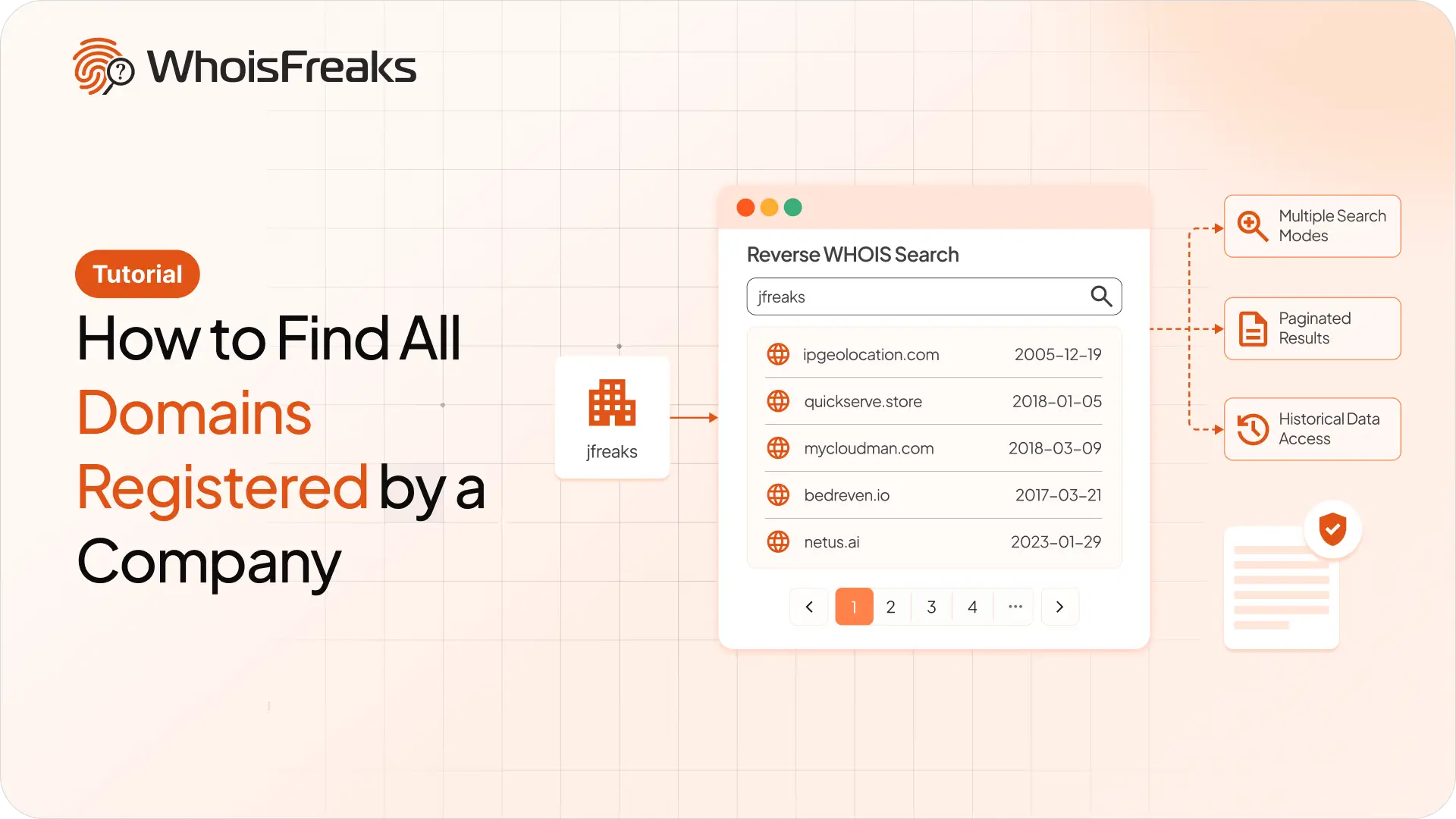
Use reverse WHOIS to find every domain a company registered. Pick the right search mode, page through results, and know what redaction hides.
9 min read

Pull WHOIS, live DNS, and subdomains from WhoisFreaks in XSOAR. Score the domain before any block fires. Auto-block high-risk or route to analyst review.
12 min read

ExpiredDomains.net does not offer any API to integrate its services into customer infrastructure. To access expired or deleted domain names via an API, you would need to rely on scraping or third‑party providers.
9 min read