
Blog
ExpiredDomains.net Has No API - Here Are Your Programmatic Alternatives

Written By Nadeem Khan, WhoisFreaks Team Published: April 06, 2026, Last Updated: August 26, 2026
Blog
Written By Nadeem Khan, WhoisFreaks Team Published: April 06, 2026, Last Updated: August 26, 2026
If you've ever tried to automate your workflow around expired domains, you've probably hit the same wall thousands of developers encounter: ExpiredDomains.net offers no API. This limitation forces anyone looking to build programmatic pipelines to get creative with alternative data sources.
The good news? Several viable paths exist for developers and domain investors who need automated access to expiring domain data. This article breaks down exactly what your options are in 2026 and how to architect a solution that doesn’t depend on a site that was never designed for programmatic access.
Expired domains are domain names that were previously registered but have become available for registration again after the original owner failed to renew them at the end of their registration period. When a domain expires, it goes through several status changes, including grace period, redemption period, and finally, pending delete. Pending delete domains are in the final stage before being released to the public, making them highly sought after by domain investors and SEO professionals.
The process of acquiring expired domains involves monitoring domain status, extracting data on expiration and availability, and analyzing historical trends to identify domains with existing traffic and strong SEO value. These domains often retain backlinks and established authority, which can provide a significant boost to new projects or existing websites. By understanding the lifecycle of domains and leveraging tools and APIs to extract relevant data, users can efficiently find and register valuable expired domains that align with their business or SEO goals.
Whether you’re looking to capitalize on existing traffic, build a portfolio of high-value domains, or enhance your online presence, understanding how to navigate the world of expired domains is essential. The right approach can help you identify domains with the best potential for SEO, traffic, and long-term value.
Let’s address the elephant in the room directly. ExpiredDomains.net’s own FAQ page answers the question “Can I have access to your API?” with a simple and definitive response: no. There is no API available—public or private, free or paid.
This has been the case for years and remains true in 2026. The platform provides access solely through its web interface and manual CSV exports. Even if you create or log in to your account, there is still no API or programmatic access available.
Despite maintaining a database of 726.5 million total domains across 677 TLDs, the site has never prioritized programmatic access.
What does this mean practically for developers?
No integration options with other tools
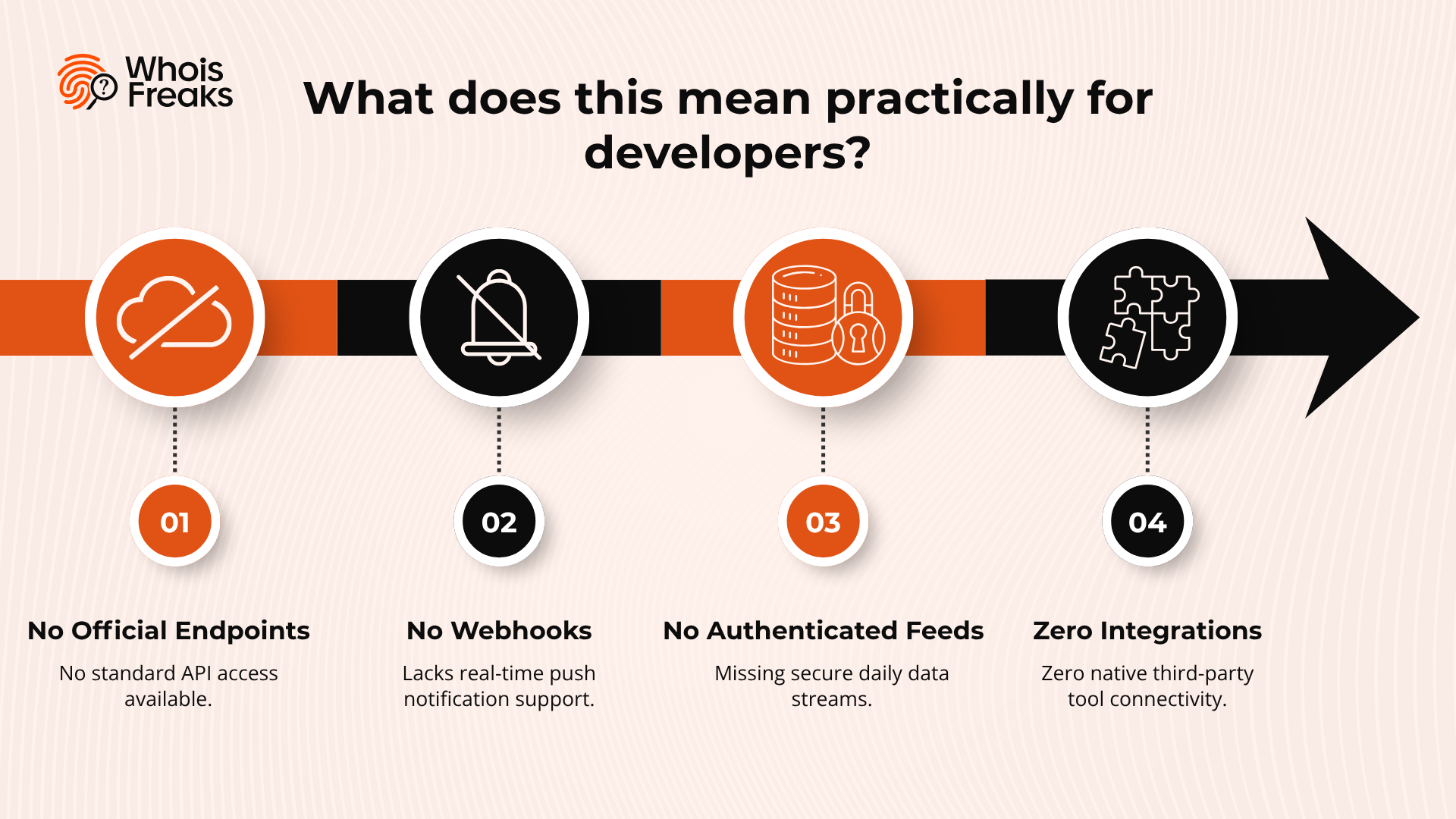
Any automation you attempt directly against ExpiredDomains.net is, by definition, scraping. This matters because scraping must respect the site’s Terms of Service and robots.txt directives. Violating these creates legal exposure and operational risk through IP blocking.
The rest of this article focuses on concrete, programmatic alternatives rather than hacks around the missing API. Whether you’re a domain investor building acquisition pipelines or an SEO professional hunting for good domains with existing traffic, these approaches will serve you better than fighting a site that doesn’t want to be automated.
WhoisFreaks offers coverage across more than 1,528 TLDs, significantly surpassing the scope of ExpiredDomains.net. Their service delivers both expired and deleted/dropped domains on a daily basis, enriched with WHOIS and DNS records to provide deeper domain intelligence.
WhoisFreaks provides both APIs and a dashboard to access daily feeds of dropped and expired domain name. Their APIs allow you to download CSV files containing domain lists alone, or enriched with WHOIS and DNS data, giving you flexible options for integrating domain intelligence into your workflows.
Data |
Description |
|---|---|
Domain name |
The actual expired domain |
TLD |
Top-level domain extension |
WHOIS |
Real-time WHOIS record of domain |
Domain Status |
Whether domain is in pending delete status |
Expiry Date |
Expiry date of domains |
DNS |
Provides DNS data of a domain |
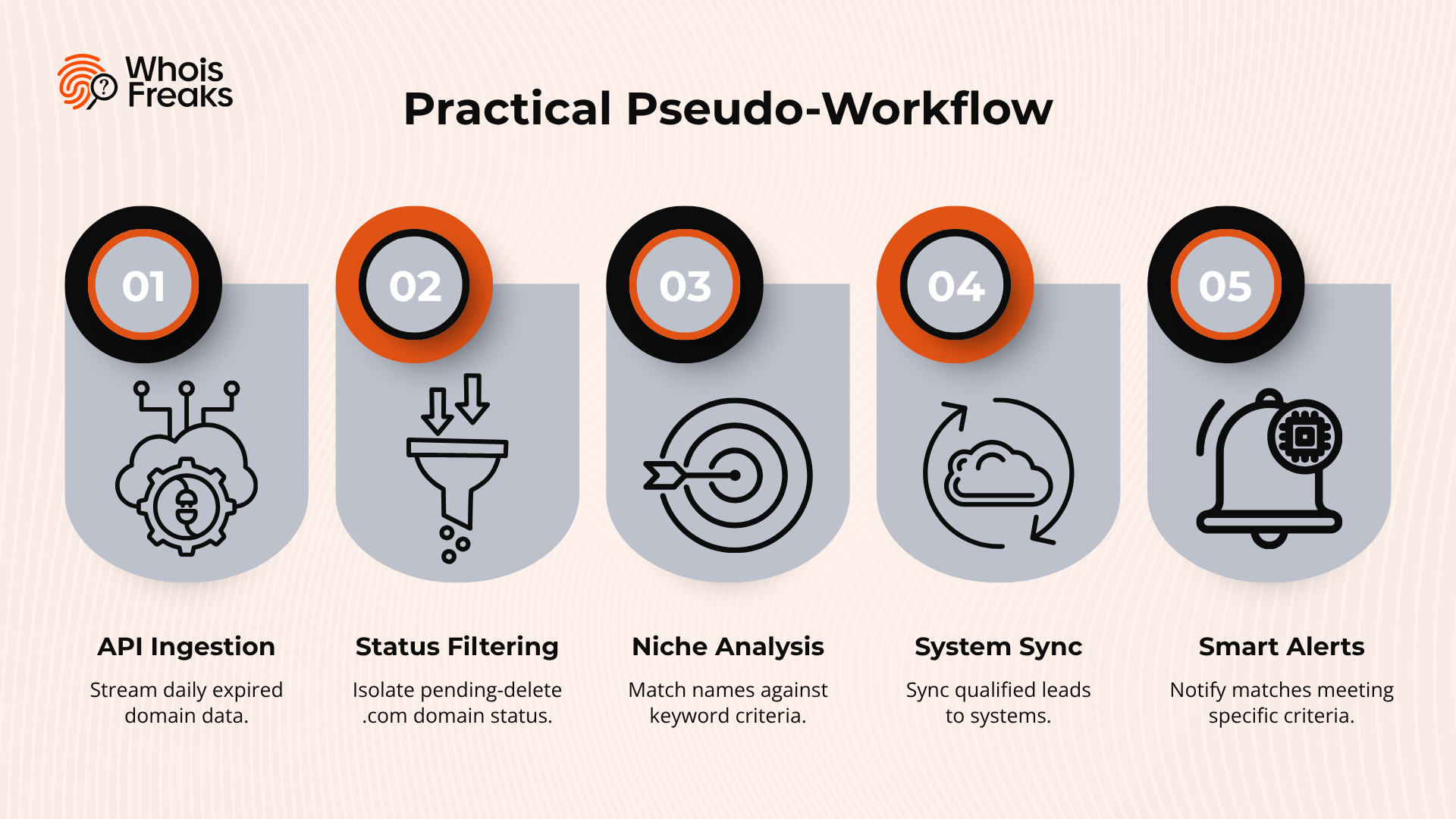
Here’s a simple automation pattern many domain investors use:
Disclaimer: Scraping may violate site terms depending on how it’s conducted. This section is descriptive, not legal advice. Always consult your own legal counsel before implementing any scraping solution.
Although no official API exists, modern scraping frameworks can bridge the gap. These tools can crawl web pages and extract data from websites, including expired domain lists. Some scraping solutions, like WebScrapeAI, automate the process of finding and extracting data from expireddomains.net and other marketplaces. Tools like Selenium, Playwright, and similar libraries allow you to fetch HTML pages and parse them to generate a daily feed of expired domains. However, this approach requires building the solution from the ground up.
Feature |
Purpose |
|---|---|
Rotating proxies |
Avoid IP blocking |
JavaScript rendering |
Handle dynamic content |
CAPTCHA mitigation |
Bypass anti-bot measures |
Geo-targeting |
Access region-specific content |
Request scheduling |
Manage rate limits |
WebScrapeAI Scraper, for example, can extract detailed domain information including domain status, backlinks, creation date, and availability across multiple TLDs, with optional filtering and sorting by SEO metrics.
Scraping is inherently brittle:
For teams that need reliable, production-grade access to expired domain data, scraping should be viewed as a stopgap rather than a foundation.
This is the more advanced, infrastructure-heavy path for teams that need full control and are comfortable dealing with registry-level data. If you’re building serious domain acquisition infrastructure, this approach offers maximum flexibility. When ingesting zone files and running WHOIS lookups, many tools provide default settings for processing and filtering domains, making it easier to get started. Additionally, analyzing historical data from WHOIS and zone files can provide deeper insights into domain ownership and usage patterns.
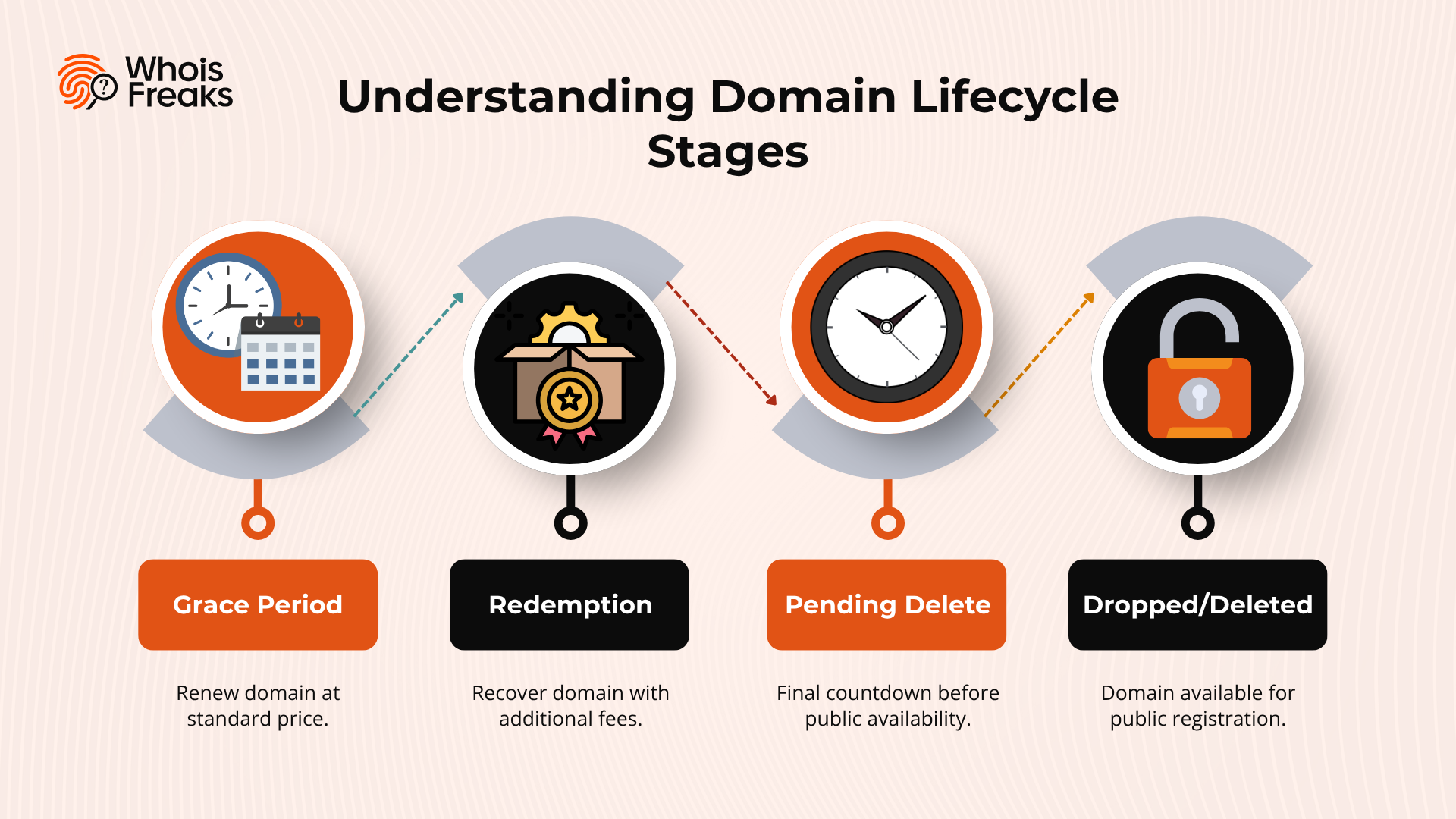
When a domain expires, it doesn’t immediately become available. The timeline typically looks like this:
Stage |
Duration |
What Happens |
|---|---|---|
Grace Period |
~30 days |
Owner can still renew at standard price |
Redemption Period |
~30 days |
Domain can be recovered for additional fee |
Pending Delete |
~5 days |
Final countdown before public availability |
Deleted |
Day 0 |
Domain becomes available for registration |
By tracking domains through these stages, you can identify called dropped domains before they hit public marketplaces.
Running your own WHOIS infrastructure is complex and often restricted by registry rate limits.
WhoisFreaks simplifies this by offering live WHOIS lookups across more than 1,528 TLDs. It aggregates records from multiple sources, including the WHOIS protocol, RDAP protocol, and proprietary scrapers. In addition, the bulk WHOIS lookup tool lets you query an entire list of expired and deleted domains at once.
WhoisFreaks services handle the infrastructure, rate limits, and data normalization, letting you focus on the business logic.
Advantages:
Disadvantages:
ExpiredDomains.net’s core strength is combining domain lists with SEO indicators—backlink count, referring domains, domain authority, spam signals. If you rebuild the domain sourcing elsewhere, you still need metrics to evaluate quality and seo value.
Platform |
Key Metrics Available |
|---|---|
Ahrefs |
Domain Rating (DR), backlinks, referring domains, organic traffic |
Majestic |
Trust Flow, Citation Flow, referring domains, topical trust |
Semrush |
Authority Score, backlinks, organic keywords |
WhoisFreaks |
Only backlinks count are available for deleted domains |
All of these tools expose APIs that can return comprehensive link data for arbitrary domains.
Developers commonly apply filters like:
This won’t replicate ExpiredDomains.net’s exact interface—but once automated, it can exceed the site’s depth and customization. You control the filters, the scoring logic, and the output format.
The cost is recurring API consumption from multiple SEO vendors. But for serious domain acquisition operations, this investment often pays for itself through better domain selection and faster workflows.
The pragmatic approach in 2026 is to orchestrate multiple explicit APIs rather than relying on ExpiredDomains.net as a programmatic backbone. Here’s a text-based architecture sketch walking through an end-to-end flow.

Step 1: Source of Expiring Domains
Step 2: Enrich with WHOIS Data
Step 3: Fetch SEO Metrics
Step 4: Run Content-History Analysis (Optional)
Step 5: Store and Expose via Internal API
ExpiredDomains.net remains valuable for ad-hoc research and cross-checks. Its free access and massive coverage make it excellent for manual exploration. But it’s no longer the central programmatic source—just one tool among many.
ExpiredDomains.net does not offer any API to integrate its services into customer infrastructure. To access expired or deleted domain names via an API, you would need to rely on scraping or third‑party providers. However, scraping comes with significant limitations such as IP blocking, request failures, and other reliability issues.
In contrast, WhoisFreaks delivers deleted and expired domain name lists enriched with WHOIS data, DNS records, and backlink counts through a robust API for seamless integration into your systems. Additionally, WhoisFreaks provides a dashboard that serves as a hub for dropped domains, complete with advanced filters to refine your search.
Get started today and supercharge your domain intelligence with access to expired and deleted domains, enriched with WHOIS and DNS data.

Pending delete is the final stage before a domain is released and cannot be recovered by its owner. The only way to acquire it is via backorder or drop-catching services. Prevent domain loss by enabling auto-renew and setting reminders.
9 min read

Discover the key differences between dropped and expired domains and learn why it matters for your online strategy. Read more to optimize your choices.
14 min read