
Blog
How to Access and Utilize Newly Registered Domains for Security and Business Insights

Written By Qasim, WhoisFreaks Team Published: March 14, 2025, Last Updated: August 24, 2026
Blog
Written By Qasim, WhoisFreaks Team Published: March 14, 2025, Last Updated: August 24, 2026
A newly registered domain (NRD) is a domain name added to the global DNS for the first time, or re-registered after a drop period, within a recent time window. Most providers define "newly registered" as domains created within the past 7 to 32 days. WhoisFreaks tracks NRDs across 1,528 TLDs and updates its feed daily, covering domains registered within a 4-month window to capture ccTLDs that publish registration data late.
Every day, approximately 200,000 to 300,000 new domains enter the global DNS. Cybersecurity teams, brand protection analysts, domain investors, and marketing researchers all monitor this stream using newly registered domains API for different reasons: to detect phishing infrastructure before it is used, to catch trademark-infringing registrations within hours, to spot emerging competitor brands, and to identify trending keywords in a target market.

This guide explains what NRD data contains, how to access it for free and via paid feeds, and how to apply it across threat detection, brand protection, and business intelligence workflows.

Not all newly registered domain feeds provide the same level of detail. Understanding the data fields available in a standard NRD dataset helps you evaluate which access method fits your workflow before subscribing to any service.
A domains-only NRD feed delivers a flat list of domain names registered within the target time window. This is the fastest and smallest format, suitable for blocklist ingestion, DNS filtering pipelines, and bulk SIEM enrichment where you plan to enrich each domain separately using a live lookup tool.
An enriched NRD feed combines the domain list with parsed WHOIS and DNS data attached to each record. The fields available in a typical enriched NRD dataset include:
| Field Category | Fields Included |
|---|---|
| Domain Identifiers | Domain name, TLD, registrar name, registrar IANA ID |
| Registration Dates | Created date, updated date, expiration date |
| Registrant Contact | Name, organization, street, city, state, postal code, country, phone, email (where not redacted by RDAP privacy) |
| DNS Records | NS records, MX records, A/AAAA records, TXT records, SOA value |
| IP and Hosting Metadata | Primary IP address, ASN number, hosting organization, geolocation (country, region, city, latitude, longitude) |
| Abuse and Security Signals | Abuse contact email, DMARC presence and value, domain status flags |
WhoisFreaks delivers all of these fields as part of its Newly Registered Domains feed, covering 1,528 TLDs with gTLD files available by 5:00 PM UTC and ccTLD files by 3:00 AM UTC daily. Current-day gTLD files are typically available around 5:00 PM UTC. A free daily sample of 1,000 domains is available without a subscription for evaluation.
For security operations teams integrating NRD data into a SIEM or SOAR pipeline, the enriched format is the correct choice. The ASN field and IP organization field allow you to flag newly registered domains already resolving to known bulletproof hosting providers or repeat-offender ASNs without running a separate lookup on each domain. For brand protection workflows, the registrant name and organization fields (where available) allow you to match against known threat actor aliases and detect registrations tied to specific bad actors before they launch an attack.
Monitoring newly registered domains offers many benefits:

There are three primary methods for accessing newly registered domain data, ranging from free daily samples to real-time enriched feeds via API. Each method differs in coverage, format, data freshness, and enrichment level.
WhoisFreaks publishes a free daily sample of the previous day's gTLD registrations as a compressed CSV file. This sample covers a representative subset of the full feed. To download it without creating an account, access the public file endpoint directly:
https://files.whoisfreaks.com/v3.1/download/domainer/sample/gtld/cleaned
https://files.whoisfreaks.com/v3.1/download/domainer/sample/cctld/cleaned
The file contains domain names with cleaned WHOIS data and is updated once per day. This method is appropriate for testing your ingestion pipeline, evaluating data structure, or running a one-time keyword search across recent registrations. It is not suitable for production threat intelligence workflows because it contains only a subset of the full day's registrations.
Several public GitHub repositories publish daily NRD lists sourced from zone file diffs and open registrar data. These lists are domains-only (no WHOIS or DNS enrichment) and typically lag the official zone files by 12 to 24 hours. They are useful for DNS blocklist maintenance and non-commercial security research. Searching GitHub for "newly-registered-domains" will surface the most active repositories. Community lists vary in TLD coverage and may not include ccTLDs.
For production-level use cases requiring complete TLD coverage, WHOIS fields, and DNS enrichment, a WhoisFreaks Domainer Subscription provides daily CSV files delivered to your dashboard for download or via API. Coverage includes 1,528 TLDs. Files are segmented by gTLD and ccTLD and include separate WHOIS, cleaned WHOIS, and DNS packages. This is the correct access method for threat intelligence operations, brand monitoring pipelines, and any use case where you need registrant contact data attached to the domain.
For a deeper technical breakdown of free versus paid NRD access options, specific API endpoint documentation, and feed format comparisons, see the complete guide to NRD access methods.
Security operations teams use newly registered domain feeds as an early-warning layer. Because most phishing infrastructure and malware command-and-control domains are registered within days of their first use, blocking or flagging domains from the NRD feed before they appear in threat feed databases provides a detection window that reputation-based tools miss.
The following workflow applies to any security team with access to an enriched NRD feed and a SIEM or DNS filtering layer.
Download the previous day's enriched gTLD and ccTLD files via the WhoisFreaks Newly Registered Domains API or dashboard. Parse the CSV and load all domain records into your enrichment or scoring pipeline. If your SIEM supports direct file ingestion, configure a daily scheduled task to pull and load the files automatically.
Run a keyword match against all domain names in the feed using a list of brand names, product names, executive names, and common phishing patterns relevant to your organization. Include common typosquatting mutations: character substitution (rn for m), hyphen insertion, TLD variations (.com vs .co, .net vs .net-secure). Flag any domain that matches.
For each flagged domain, evaluate the following enrichment signals from the NRD record:
| Signal | Risk Indicator |
|---|---|
| Registration age | Domain registered within the last 24 to 72 hours with immediate DNS resolution is a high-risk pattern |
| Registrar | Known high-abuse registrars (e.g., registrars with consistently high UDRP complaint rates) are a risk multiplier |
| DMARC absence | No DMARC record on a domain mimicking a legitimate brand indicates likely phishing infrastructure |
| Hosting ASN | Resolution to a bulletproof hosting ASN or anonymous VPS provider with no legitimate business presence |
| Registrant privacy | Registrant fields completely redacted via RDAP privacy combined with immediate DNS resolution is a common phishing pattern |
For any domain scoring above your risk threshold, run it through a live WHOIS lookup to confirm current registration status and compare the registrant details against known threat actor patterns from previous incidents. WHOIS history lookup can confirm whether a domain was previously owned by a known threat actor before being dropped and re-registered.
Submit confirmed high-risk domains to your DNS firewall, proxy blocklist, or email gateway for blocking. Document the domain, the risk signals that triggered the flag, and the detection date for your incident log. NRDs that score high but are not yet confirmed malicious should be placed in a monitoring watchlist for 7 to 14 days. If DNS records change rapidly or the domain begins serving content, escalate for investigation.
This workflow reduces the detection gap between a domain registration event and its first appearance in commercial threat feeds, which typically ranges from 48 to 96 hours after a domain is weaponized.

Brand protection teams use NRD monitoring to catch trademark-infringing domain registrations before they are used in customer-facing attacks. The window between a typosquatting domain being registered and its first phishing email being sent is often less than 48 hours. Daily NRD monitoring narrows that window to hours.
Build a list of exact-match brand names, product names, executive surnames, common misspellings, and high-value trademark terms. For a company named "Acme Financial," a minimal monitoring list would include: acmefinancial, acme-financial, acmefinancials, acmefinanical, acmefinansial, acmebank, and any phonetic or visual substitution variants.
For each matching domain, check whether it: resolves to a live IP address (high urgency), has MX records configured suggesting email infrastructure is already in place (high urgency), uses WHOIS privacy to obscure the registrant (common tactic in typosquatting), or has name servers pointing to hosting providers associated with prior brand abuse cases.
If a domain clearly infringes on a registered trademark and is resolving to a live site or email server, document the registration evidence (domain name, registration date, registrar, all available WHOIS fields) and initiate a Uniform Domain-Name Dispute-Resolution Policy (UDRP) complaint. The registration date from the NRD record establishes when the infringement began. A WHOIS history API can confirm whether the domain was previously owned by a legitimate party before being abandoned and re-registered by a squatter, which is critical evidence for a UDRP complaint.
Tracking newly registered domains is essential for:
Newly registered domains are only one end of the age range. Domains registered years ago and left dormant carry a measurably higher malicious rate, which is covered in domain age as a threat signal.
Using WHOIS database records, daily updates, and domain intelligence, you can identify threats, protect your brand, and stay ahead in the digital world.
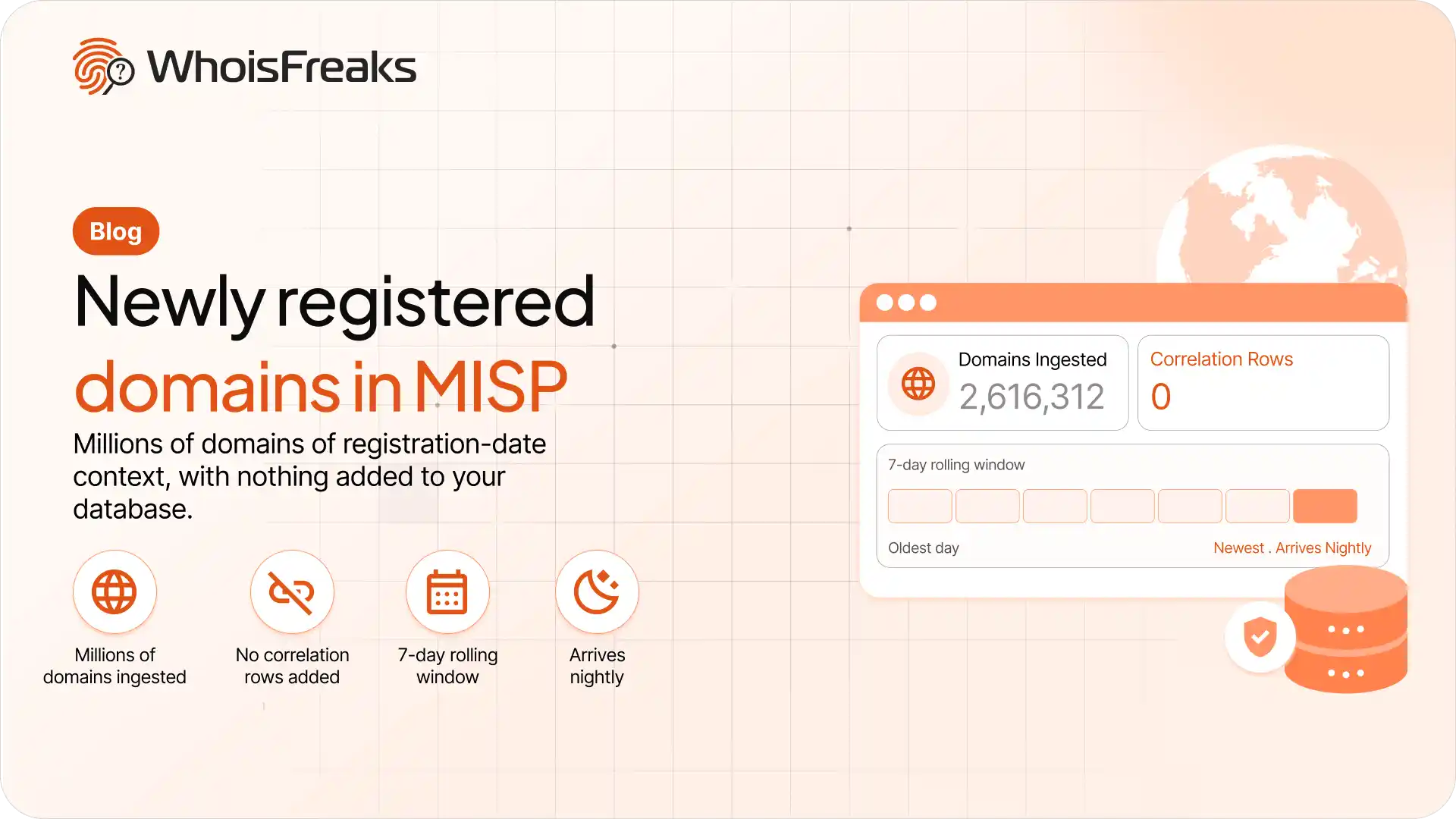
Quick answer. A newly registered domain (NRD) feed in MISP flags how old a domain is at the moment an analyst looks at it. WhoisFreaks publishes NRD data as a local MISP feed directory, so MISP pulls it on its own schedule with no API key between the two systems. Run it in cache-only mode and you get the freshness signal and the exact registration date, with zero events, zero attributes, and zero correlation rows in the database. Cache or fetch? Start here MISP has two independent ways to con
14 min read

Three lookalike domain attack types, one detection framework. Catch typosquatting, homoglyphs, and combo-squatting using WHOIS and DNS signals.
14 min read

WhoisFreaks offers daily & historical domain data with WHOIS/DNS insights for threat analysis.
9 min read