What Is Passive DNS and How Does It Differ From Active DNS?
Written ByUsama Shabbir, WhoisFreaks Team Published: October 12, 2026, Last Updated: November 25, 2026
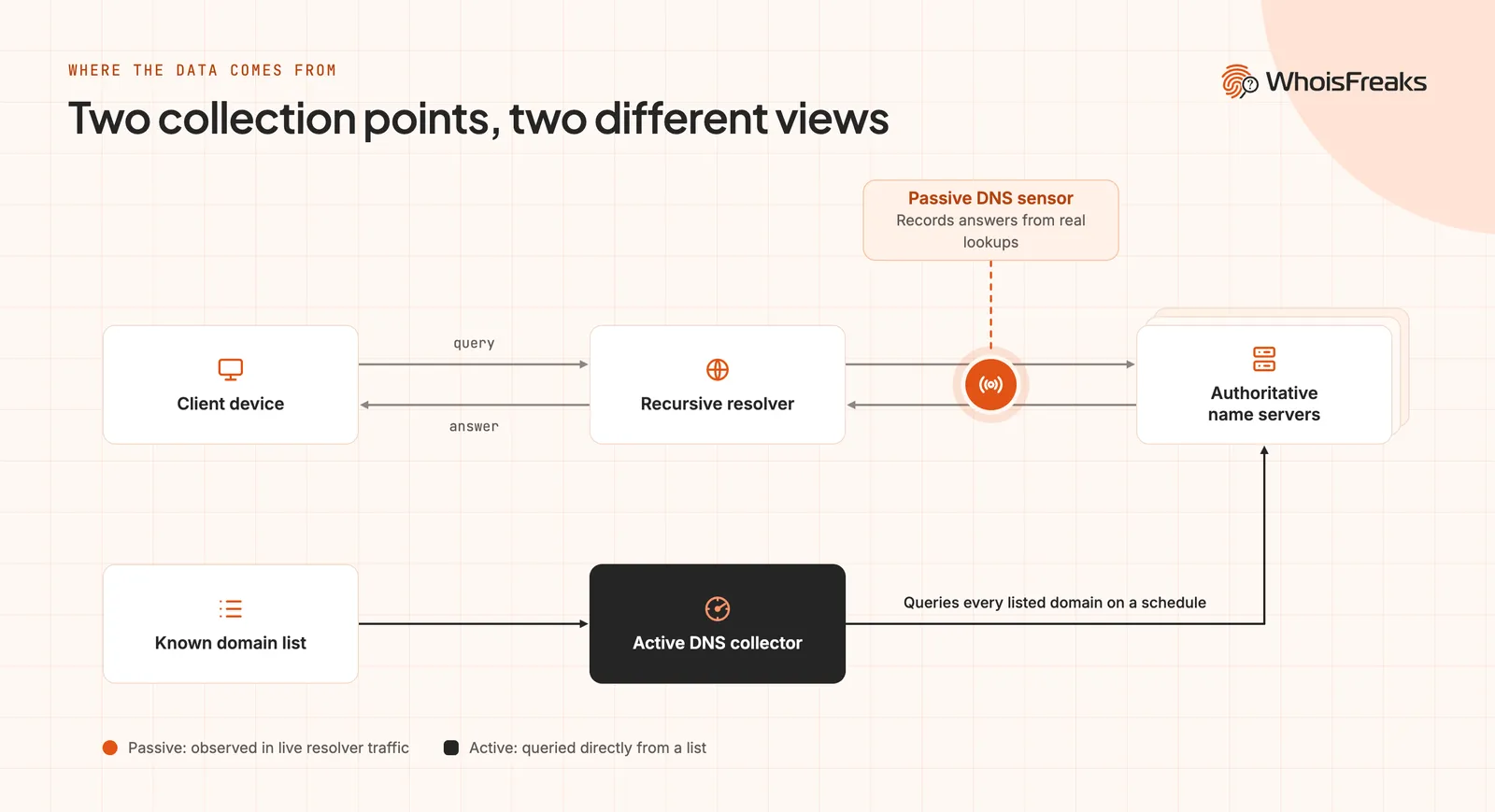
Passive DNS is a historical record of DNS answers captured from real resolver traffic, while active DNS is built by querying domains directly on a schedule. Both answer the question every investigation eventually reaches: where did this domain point before today?
The difference lies in what each method can see. Passive DNS only knows about names that someone looked up. Active DNS only knows about names its collector has already found. A SOC analyst who understands those two blind spots can tell when a clean result means "nothing happened" and when it means "nobody was watching."
TL;DR: Passive DNS records answers observed between recursive resolvers and authoritative servers, so it captures real usage and short-lived changes but misses domains nobody has queried yet. Active DNS resolves a known list of domains itself, so it sees idle and newly registered domains but can miss changes that happen between resolution cycles. WhoisFreaks offers a passive DNS database for analysts that is built on active collection, which is why it covers the gaps that sensor-based passive DNS leaves.
What Is Passive DNS?
Passive DNS is a method of collecting DNS data by recording the answers that resolvers receive from authoritative name servers during normal internet use. Sensors capture those responses, strip out who asked, and store each answer with a first-seen and last-seen timestamp. The result is a searchable history of which IPs, name servers, and mail servers a domain has used, without ever sending a query to the domain itself.
Florian Weimer described the technique as passive DNS replication in his 2005 paper presented at FIRST. His design used sensors that captured DNS packets on production networks, filtered them, and forwarded them to an analyzer for storage. Most passive DNS services still follow that model.
Privacy is handled by where the sensor sits. According to M3AAWG's passive DNS technology summary, privacy-respectful providers collect only the traffic above the recursive resolver, so end-user identities never enter the dataset.
Each stored record usually carries the queried name, the record type, the answer, and timestamps for when it was first and last observed. The IETF Passive DNS Common Output Format draft standardizes these as fields such as rrname, time_first, and time_last, which is why passive DNS data from different providers looks broadly similar.
What Is Active DNS?
Active DNS is a method of collecting DNS data by sending queries to domains from a known list and storing the answers. Instead of waiting for someone to look up a name, the collector resolves every domain it knows about on a fixed cycle. That makes coverage depend on the size of the domain list, not on how popular each domain is.
The research community has run this approach at scale for years. The OpenINTEL project, described in van Rijswijk-Deij et al.'s 2016 IEEE JSAC paper, collects daily measurements for every domain under .com, .net, and .org, which together cover about half of the global DNS namespace.
Passive DNS vs Active DNS: Key Differences
The two methods produce records that look alike but come from opposite directions. The table below compares them on the points that matter during an investigation.
Factor
Passive DNS
Active DNS
Collection point
Sensors between resolvers and authoritative servers
Collector querying domains directly
What creates a record
A real user or system looking up the name
The domain appearing on the collector's list
Newly registered, unused domains
Not visible until someone queries them
Visible once discovered
Short-lived changes
Captured if queried during the change
Missed if the change falls between cycles
Low-traffic domains
Often missing
Covered if on the list
Record types
Only types that clients requested
Every type the collector asks for
User privacy
Requires aggregation above the resolver
No user data involved
Answer consistency
Varies with sensor locations
Varies with collector location
Neither column wins outright. The right question for an analyst is which gap affects the case in front of them.
Where Sensor-Based Passive DNS Leaves Gaps
Domains nobody has queried yet
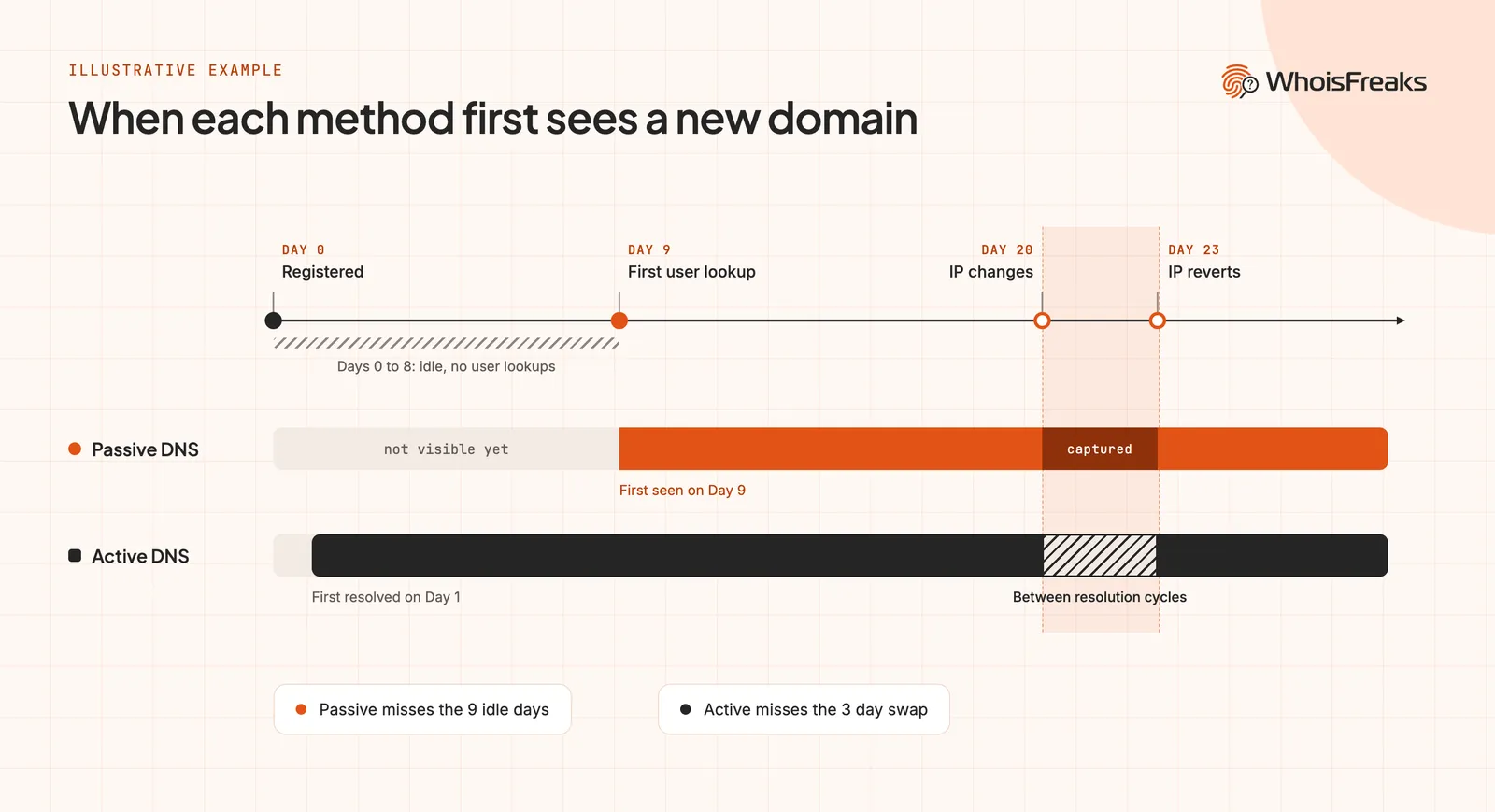
A passive sensor only records a name after someone resolves it. Phishing operators often register domains in bulk and leave them idle until a campaign starts, which means the most useful early warning sits exactly where passive DNS is blind. Zhauniarovich et al.'s 2018 survey on malicious domain detection makes this point directly: an active collector working from zone files can find a newly registered domain before it is used, while passive sensors cannot see it yet.
Low-traffic and niche domains
Sensor coverage tracks traffic. M3AAWG notes that global sensor deployment catches most domains in active use, but that some obscure or little-used domains may escape detection.
Real campaigns show how wide that gap can be. In a 2023 Infoblox analysis of a phishing campaign reported by CISA, about 85% of the indicators published in open-source reporting were never seen in Infoblox customer networks. For a targeted campaign aimed at a few organizations, many domains will never cross a given sensor network at all.
Records nobody asked for
Passive DNS stores answers to the questions clients actually asked. If no client requested a domain's MX, TXT, or SOA records during the observation window, those records may be thin or absent in the passive DNS data. An analyst checking when a domain added a mail server or a verification TXT record can come up empty even though the record existed.
Where Active DNS Has Its Own Blind Spots
Active collection trades one set of gaps for another. The largest is timing. Every domain gets resolved on a cycle, and anything that changes and changes back between two resolutions leaves no trace. Fast-flux setups and short IP swaps during a campaign are exactly the behavior that shows up in passive DNS and can slip past an active collector.
Coverage is also capped by discovery. An active collector cannot resolve a hostname it has never heard of, so its view of subdomains depends on how well it finds them. Sources such as certificate transparency logs and the WhoisFreaks Subdomains API exist to close that gap, but no discovery method is complete.
The same survey flags two more limits. Active data is not linked to user behavior, so it cannot show which domains real victims resolved or how often. And the answers it collects depend on where the queries come from, since CDNs and geo-DNS return different IPs to different locations.
For domains already on your watchlist, the timing gap has a practical fix: monitor a domain's DNS records for changes at a short interval rather than relying on the database refresh cycle.
How WhoisFreaks Builds Its Passive DNS Database
From the analyst's side, WhoisFreaks works as a passive DNS database: a passive DNS lookup returns historical records with first-seen and last-seen dates, and the target domain never receives a packet from you. Underneath, the data is collected actively. M3AAWG notes that some passive DNS services augment sensor data with active probing or zone file data, and WhoisFreaks takes that approach further by building the whole dataset from discovery and resolution.
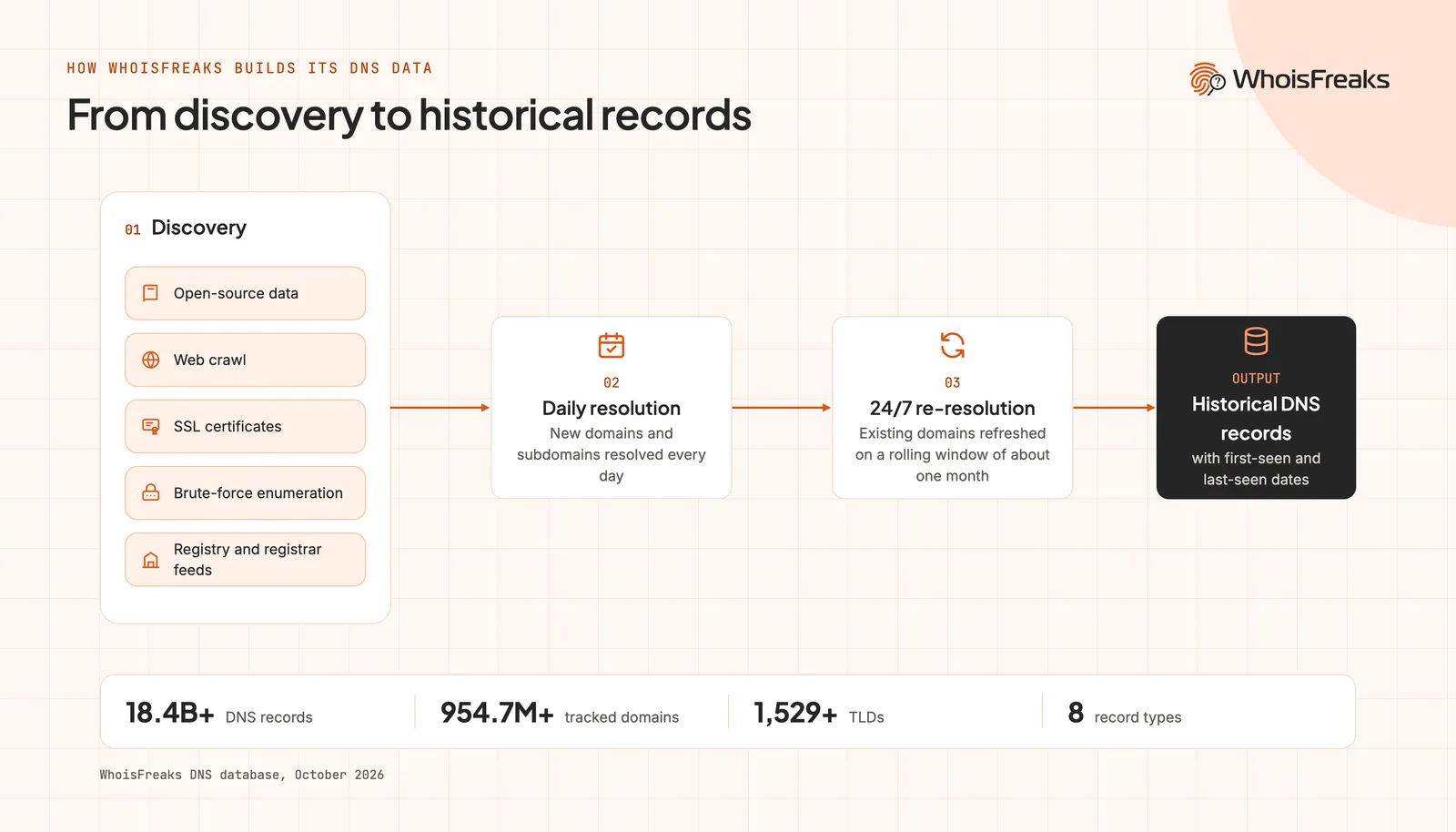
The pipeline has three stages:
Discovery. Multiple crawlers find domains and subdomains from open-source data, web crawling, SSL certificates, brute-force enumeration, and custom feeds from registries and registrars.
Daily resolution. Newly discovered domains and subdomains are resolved every day, and their live DNS records are stored.
Continuous re-resolution. A separate crawler runs around the clock and re-resolves domains already in the database on a rolling window of about one month, adding millions of DNS records each day.
Based on the WhoisFreaks DNS database, that process covers 19.2B+ DNS records across 974.4M+ tracked domains (690.6M+ currently active) and 7,848+ TLDs and SLDs. Records span eight types: A, AAAA, CNAME, NS, MX, SPF, TXT, and SOA. The subdomain index holds 6.8B+ hostnames.
The trade-off is the one described in the previous section. A newly registered domain gets resolved within a day, but an established domain's latest snapshot can be up to a month old, so a change that flips and reverts inside that window may not appear. Teams that need the same data inside their own tools can query it through the DNS History API.
Investigating a Phishing Domain With Historical DNS
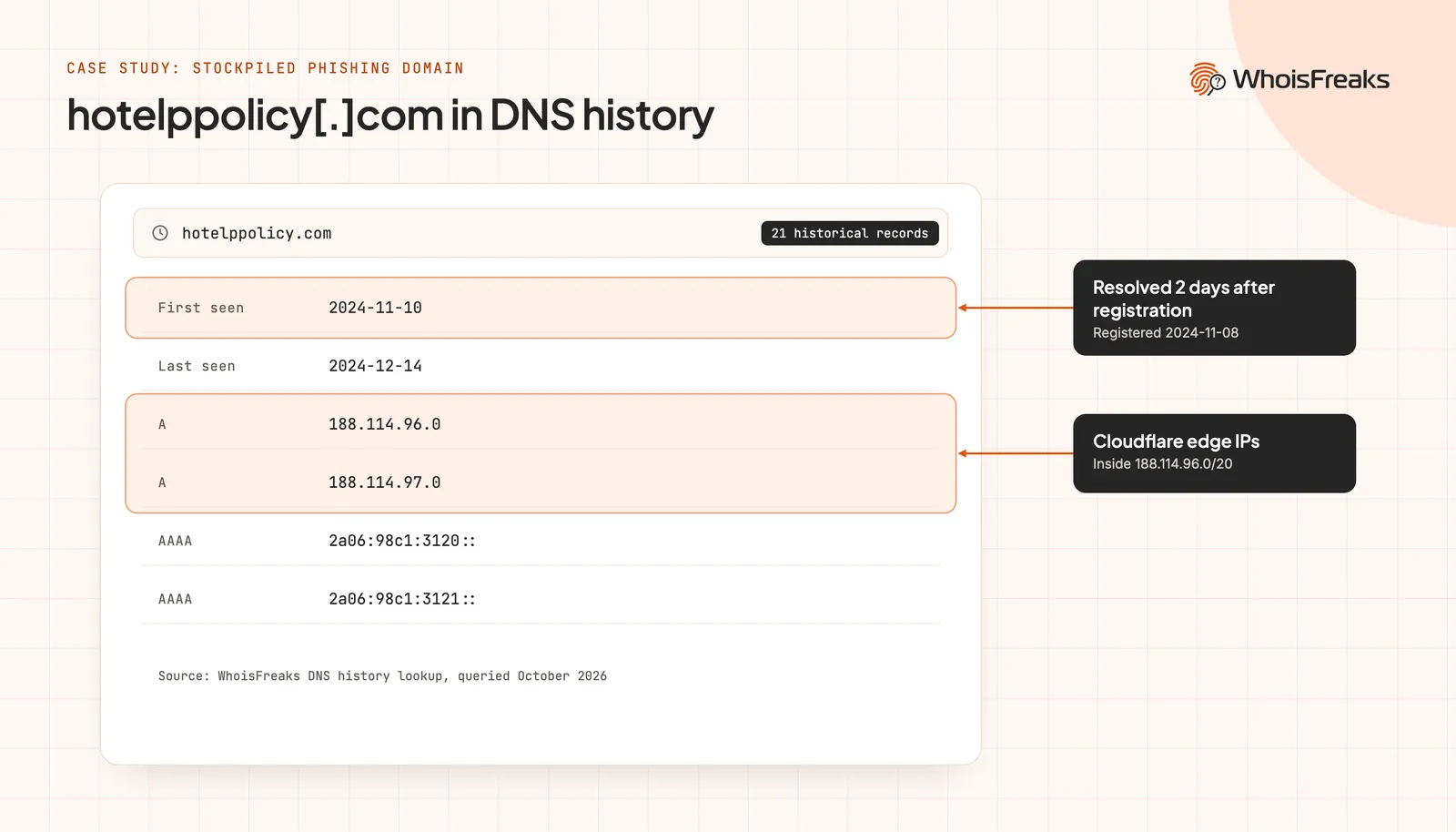
In November 2024, Unit 42 reported that a single threat actor had registered more than 550 domains impersonating booking sites, banks, crypto wallets, and restaurants. Many were stockpiled and not yet in use. One of them, hotelppolicy[.]com, was registered on November 8, 2024.
Three things stand out. The domain was first seen two days after registration, during the period when Unit 42 describes these domains as stockpiled, which is the window where a sensor-only dataset is most likely to have nothing. The records stop after December 14, which gives a clear activity window for scoping any related alerts.
The IP addresses tell a less obvious story. Both IPv4 addresses sit inside Cloudflare's published 188.114.96.0/20 range, and both IPv6 addresses fall inside 2a06:98c0::/29, according to Cloudflare's IP ranges page. That matches Unit 42's note that 90% of the active domains in this campaign sat behind Cloudflare. Pivoting on those IPs would return thousands of unrelated sites, so the IP is a dead end here.
The better pivot is the registration data. Unit 42 published the Gmail address used as the registration contact for the whole set, and a reverse WHOIS search on that address is the natural way to find other domains registered with it. From there, checking the results against a phishing domains list shows which ones are already flagged and which are still unlisted. For a full walkthrough of the lookup itself, see this step-by-step guide to checking DNS history.
When to Use Passive DNS, Active DNS, or Both
Reach for sensor-based passive DNS when you need to know what real users resolved, or for passive DNS monitoring of fast-changing infrastructure such as fast-flux networks, where every short-lived answer matters.
Reach for actively collected data when the domain may never have been used: lookalike registrations, stockpiled campaign domains, and low-traffic targets aimed at a single organization. It is also the better source for MX, TXT, and SOA history.
Use both when the stakes justify it. During incident response, an empty result in one dataset is not proof of absence, and a second source with the opposite blind spot is the cheapest way to check.
Conclusion
Passive and active DNS fail in opposite places. Sensor data is strongest on busy domains and fast changes, and weakest on idle registrations and quiet targets. Active data is strongest on coverage and record depth, and weakest on what happens between refresh cycles.
Knowing which gap applies to your case tells you whether an empty result is evidence or just a blind spot. For bulk analysis across the full dataset, the WhoisFreaks DNS Database delivers the same historical records as downloadable files.
Frequently Asked Questions
Explore frequently asked questions to better understand our features, functionality, and usage.
What is passive DNS used for in security investigations?
Passive DNS is used to trace a domain's infrastructure over time. Analysts use it to find which IPs, name servers, and mail servers a malicious domain used, when those records first and last appeared, and which other domains shared the same infrastructure. That history helps scope incidents and uncover related phishing or malware domains.
Does passive DNS collect personal user data?
Privacy-respectful passive DNS does not collect personal user data. Sensors sit above the recursive resolver and record only the answers resolvers receive from authoritative servers, not which client asked. Aggregating traffic from many resolvers adds further separation between the stored records and any individual user.
Can active DNS replace passive DNS?
Active DNS cannot fully replace passive DNS, because each method misses different things. Active collection sees newly registered and low-traffic domains that sensors never observe, while passive collection captures short-lived changes and real user lookups that happen between active resolution cycles. Many investigations benefit from checking both.
How often is passive DNS data updated?
Sensor-based passive DNS updates continuously, because records arrive whenever monitored resolvers handle a lookup. Actively collected datasets update on a schedule instead. WhoisFreaks resolves newly discovered domains daily and refreshes existing domains on a rolling window of about one month, so recent changes on established domains can lag.
What is passive DNS replication?
Passive DNS replication is the original name for passive DNS, introduced by Florian Weimer in 2005. It describes capturing DNS responses from production networks with sensors and storing them in a database for later queries. The term reflects that the system copies DNS data as it flows past instead of querying name servers itself.